Monday, November 30, 2009

A thought to the weavers of dreams


Shantaram’s eyes were weary. But he couldn't’t suppress the proud smile on his face. A masterpiece all the way, he thought to himself giving the six-yard wrap one last look. A brush of colour, a touch of tradition and an entire year of laborious craftsmanship... the meticulous weaves had finally taken shape. And it had been worth all the days of working round the clock for Shantaram’s family. After tying the knots on warp and weft threads, dyeing, colouring, weaving and finishing, the beautiful Benarasi Saree was ready. Thus starts an epic novel on the hand loom weavers of the most sought after Saree in the world - The Benarasi..


Often referred to as Benares, Varanasi is the oldest living city in the world. These few lines by Mark Twain say it all: "Benaras is older than history, older than tradition, older even than legend and looks twice as old as all of them put together".Benaras or Varanasi has the pride of being the one of the most famous Hand loom centers in the entire world. In fact it is among the few centers in the world that has painstakingly preserved the ancient tradition of hand weaving. The silk used for the saris was historically imported from China. Several first-millennium Buddhist texts mention Benaras fabrics, giving the indication that Benaras has been the center of fine textile weaving for at least two millennia. The earliest mention of the brocade and zari textiles of Banaras is found in the 19th century. With the migration of silk weavers from Gujarat during the famine of 1603, it is likely that silk brocade weaving started in Banaras in the seventeenth century and developed in excellence during the 18th and 19th century. During the Mughal period, around 14th century, weaving of brocades with intricate designs using gold and silver threads became the specialty of Benaras.


Benarasi silk saris are traditionally made in four varieties:
Katan (pure silk)
organza (Kora)
Georgette sari
Shatir sari.


Traditional designs of the brocade include jasmine (chameli), thousand emeralds (panna hazar), marigolds (gendabuti), betel nut leaves (paan buti), diagonal stripes (tircha) and the corner motif with a mango flower (konia). Originally the saris were embellished with threads made from real gold and silver for use by the royal family. In modern times, this has been replaced by gold- and silver-colored thread, making the saris affordable for the general population.


Making it affordable for the masses has also led to cheap imitations flooding the market, the power loom capturing the weaver's hand loom, rendering the rich traditional obsolete and endangered.
In a bare village work shed a man sits quietly working on a loom. Look closer and you notice that he is actually sitting in a pit dug into the earthen floor. Hari Ram is middle-aged, non-descript but his fingers weave magic as he works the traditional l pit-loom. A length of pink silk slowly emerges, shimmering with gold threads worked in elaborate mango motifs. He is weaving the traditional Benarasi saree for a bride to wear at her wedding. This silk is the stuff of dreams, of dowries, of rituals and sacred traditions. today thousands of Benaras weavers like Ram have little work and it fetches a pittance. Kumaoli village, where Ram lives, once had 70 looms. Today, there are four left. In dozens of villages around the holy city hand looms lie dismantled, broken, decaying. The women and men who worked the looms have now been forced into manual work to survive.
How did things come to such a pass? A fatal combination of mechanisation, computerisation and globalisation has ruined the hand loom work of Benaras. Traditionally, people here wove only silk. Mulberry silk yarn was sourced from distant Karnataka and processed by weaver families in and around Benaras who used it to weave silk, brocade, tissue, crepe, organza and other fine materials on their hand looms. Traders from the city would come to the weaver families to buy their products. The weaver could command a decent price for his labour.
Then came the power loom. Many rich traders set up power looms and copied the traditional Benarasi designs. A power loom can churn out in one day a saree that may take a weaver 10 days to make on a hand loom. Power loom sarees are light weight and cheaper and most customers cannot tell the difference between power loom and hand loom fabric.

A dying art, an incomplete trousseau! There are organizations in support of this art, a movement that has started to protect and cultivate this rich heritage of India. This is a tribute to the craftsman, to the wonder of an age old tradition, to a movement that is forming to bring back a dying art. Let's not blindly buy imitations when the originals are not only priceless for our wardrobes but also ensuring that a weaver's family gets his due!!


The current scernario has the Human Welfare Association (HWA) demanding a separate ministry for the handloom sector. Arguing for the aggressive promotion of the Handloom Cluster Development and Handloom Mark and Silkmark schemes as well as Geographical Indicator protection for Benaras handlooms. HWA has organised public protest by weavers, burning Chinese silk and demanding a ban on dumping.

HWA also started the Taana Baana cooperative which provides livelihood to over a thousand weaver families, helping them with credit, design development and marketing support, as well as alternative income generating opportunities. It has a small retail outlet in Sarnath and a turnover of Rs. 70 lakh. But, given the scale of distress among the weavers, Taana Baana is at best a demonstration of what needs to be done for the industry as a whole.


Posted by Sujata

Monday, November 23, 2009

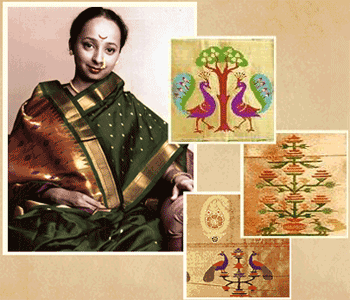
Paithani Weave Of Maharashtra


56 kms south of Aurangabad in Maharashtra, on the banks of river Godavari, there is a small town called Paithan.


The town was the capital of the Satavahana empire that ruled the Southern and Central India more than 2000 years ago. And here, during that time, some weavers started creating poetry on silk which came to be known as Paithani.


The artisans would draw threads from pure gold and silver and intricately weave them with gossamer silk threads. The fabric thus created would be so dazzling that it inspired awe in everyone. The Greeks mentioned the silk of Paithan in their records. This precious fabric used to be imported to many countries in exchange of gold and other precious metals and stones by Ancient Indian rulers. Originally meant for the women of the royal household, the Paithani silk sari was the most coveted garment of those times.


2000 years later, sheer dedication of the weavers has kept the Paithani weave still alive in India. Though not drawn from real gold anymore, expensive zari (gold or silver yarn wrapped over polyester yarn) threads, procured from Gujarat and the best quality silk from South India are intricately woven together to create the magical Paithani saris that continue to mesmerize Indian women.


The weavers use the traditional wooden looms. Multiple spindles are used to produce a linear design. The weavers count the threads of the wrap for each part of the pattern and using tiny pins, interlock the silk or gold threads on the weft. The borders have creeper or floral designs. The pallav (the end of the sari) is woven in gold and the patterns are created in silk. Distinctive motifs such as stars, peacocks, mangoes, flowers, petals and coconuts are woven on the pallav.


Weaving Paithani is time consuming. The simplest of the saris take at least a month to complete. The more ornate ones take around three months. The skill has been passed on from father to son for generations. The weaving involves minute detailing and is stressful to the eyes. But the weavers are extremely dedicated to their craft and they toil for months to create exquisite patterns and designs.


A Paithani is expensive and why not...a Paithani is almost like an heirloom. It gets passed on to the daughter from the mother in most Marathi families. The sari is precious not only for the intricate weave of pure silk and gold but also for it's significant role in the culture of Maharashtra. Wearing the Paithani, is almost like wearing a 2000 year old heritage of this glorious country.


Pictures Courtesy: Mangalam Sarees
                             Palavi Handcrafts
                             Google Images

POSTED BY APARNA

Sunday, November 15, 2009

Xewali / Shewali : Edible flower in Assamese cuisine (Night Flowering Jasmine)


Xewali phool or the Night-flowering Jasmine (scientific name:Nyctanthes arbor-tristis) is used widely in Assamese cuisine not only because of it's availability but also because of it's various medicinal properties. Assamese cuisine is fascinating to me because of it's inclusion of various herbs and greens-some of which are unique in characteristic.

In this post i am focusing the use of this flower which highlights the folk medicine culture in our food habits ....if somebody is interested an expert advice is suggested.Like many traditional Assamese household we too have this small tree or shrub right in front of our house.
The flower contains five to eight petals and a bright reddish orange centre,it is highly fragrant,if you pick the flowers your hands smell good for a very long time.One interesting fact about them is that they bloom only at night time as you can see here in these pictures.I took two shots one at day time where you can see many buds and another at night when you can clearly see the blooms.As soon as the first rays of sunlight hit them they fall ,it is a beautiful sight when you see a lovely and sweet smelling white carpet of Khewali-phool first thing in the morning...it is always rush hour for me at that time so could not manage one picture of the same.My mom-in-law and my kids collect the fallen flowers in a plate , some of which are offered to God later and most of it goes straight to the kitchen.Unlike other flowers this flower can be offered to God even if they are collected from the earth(or are fallen ).
One very interesting mythological story is attached to it...Lord Krishna brought this heavenly flower to earth ,now both of his wives Rukmini and Satyabhama wanted it to be planted at their own courtyard.Krishna solved the tiff between the two by strategically planting it at Satyabhama's courtyard so that the flowers always fell on Rukmini's courtyard.Now coming to its medicinal properties... many believe that it is a very safe de toxifying agent ,we also use decotation of its leaves for low grade fevers and body aches,many use the paste of leaves to the skin as it is believed to help in certain skin conditions.Pramathesh informed me that it is consumed empty stomach in the morning as an anti malarial agent.It is also used as a very safe purgative for kids and helps in relieving dry cough,faintness .I love it because of its unique flavour and aroma.....you can compare it very little to the flavor of Jasmine tea.
I admit that when for the very first time it was served to me i was scared to try it out but others assured me that i need not fear and must try it...and i did.I love it for its unique flavour and taste....it is prepared in various ways as i am a vegetarian i like this RICE-VERSION...where flowers are added to pre-cooked rice and fried together ,very less oil and no other spices except for turmeric and salt is used here to preserve its aroma and flavor.Assamese food is served in courses,so it is always served first because of its slight bitter taste,it is also termed as TEETA-BHAAT(bitter-rice) .Another very popular variation is FISH CURRY by adding these flowers ...loved by my kids and other family members.

A special thanks to Pramathesh and his friends from the office who helped me know the scientific name of this flower.